


Salt Stress in Winter Wheat in Karakalpakstan: How to Save Crops and Preserve Yield
Soil salinity is one of the most serious problems for agriculture in Karakalpakstan. It is especially damaging to winter wheat when the field experiences severe salt stress already from autumn. In such areas, plants develop poorly, tiller less, lag behind in growth, and in severe cases the crop may partially die out.
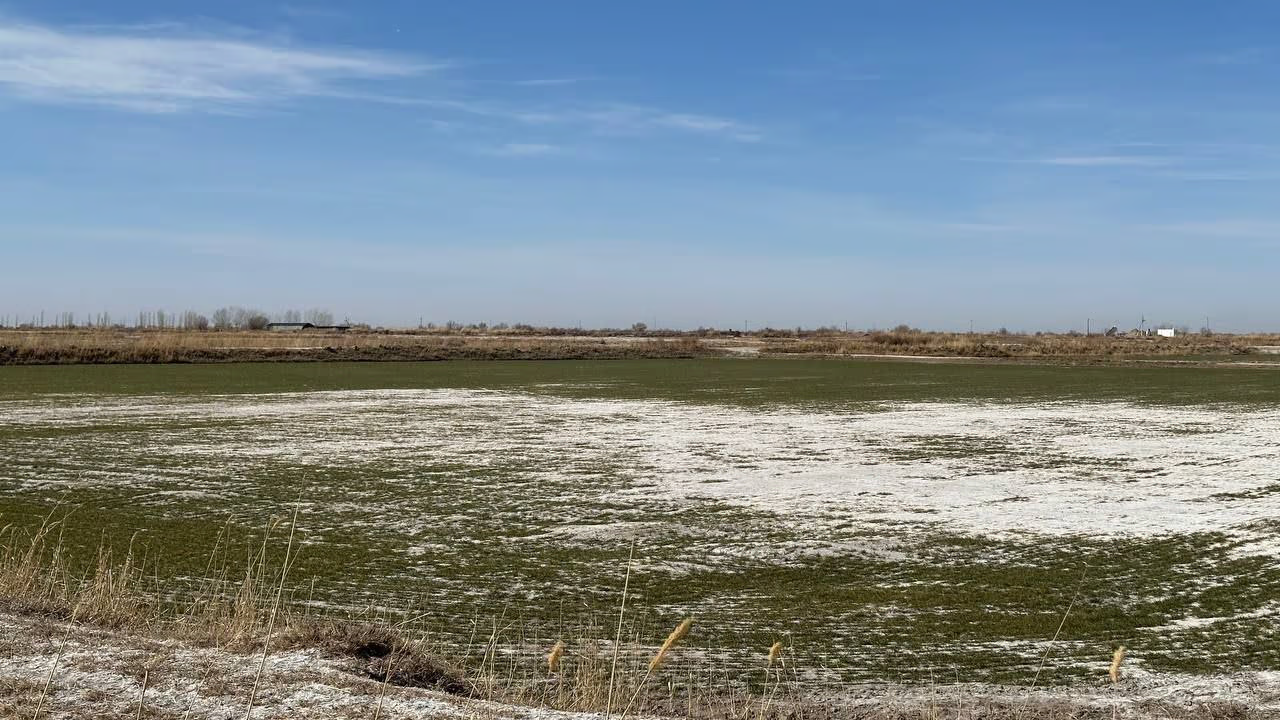
In this article, we present a real field case from Karakalpakstan, where winter wheat of the Alekseich variety was grown under conditions of pronounced soil salinity. The field is located near a drainage collector, and already in November salt clearly appeared on the soil surface — it was not snow, but a salt crust. An important point is that the soil was not leached, meaning there was no additional water used to wash salts out of the field.
Despite these harsh conditions, by early April the wheat had survived, emerged, and continued normal development thanks to the application of our treatment program using SaltiPro, Sporagin, Plantastim, and Baktomin.
Why soil salinity is so dangerous for wheat
Under saline conditions, the plant faces several problems at once.
First, the increased concentration of salts makes water uptake more difficult. Even if moisture is present in the soil, the plant experiences physiological drought.
Second, salt stress disrupts plant nutrition, suppresses root system development, and slows the growth of seedlings and tillering.
Third, under saline conditions wheat becomes weaker, tolerates temperature fluctuations less effectively, and reacts more strongly to other stress factors.
That is why, in saline fields, it is important not to wait until the problem becomes worse, but to work proactively: protect the seeds, support the crop during emergence and tillering, and help plants get through stress periods.
According to published literature, wheat is considered a moderately salt-tolerant crop: noticeable yield reduction usually begins when soil salinity reaches around ECe 6 dS/m, and beyond this threshold the average yield loss is estimated at about 7.1% for each additional 1 dS/m. In practical terms, this corresponds approximately to yield losses of about 14% at ECe 8 dS/m, 28% at 10 dS/m, 43% at 12 dS/m, and up to 64% at 15 dS/m. Reviews on salt stress also note that wheat yield decline usually becomes clearly visible in the 6–8 dS/m range, although actual losses vary greatly depending on the variety, drainage, sodicity, weather, and overall agronomic practices.
Field conditions in Karakalpakstan
This field was located in an area under strong saline pressure. A drainage collector is located near the field, which additionally affects its condition. Already in November, a salt crust was clearly visible on the soil surface. The photos show the characteristic white salinity on the field and the pronounced unevenness of the site.
At the same time, the field was not leached, meaning the technology was applied without additional water costs for salt leaching. In conditions of water shortage and high production costs, this is especially important.
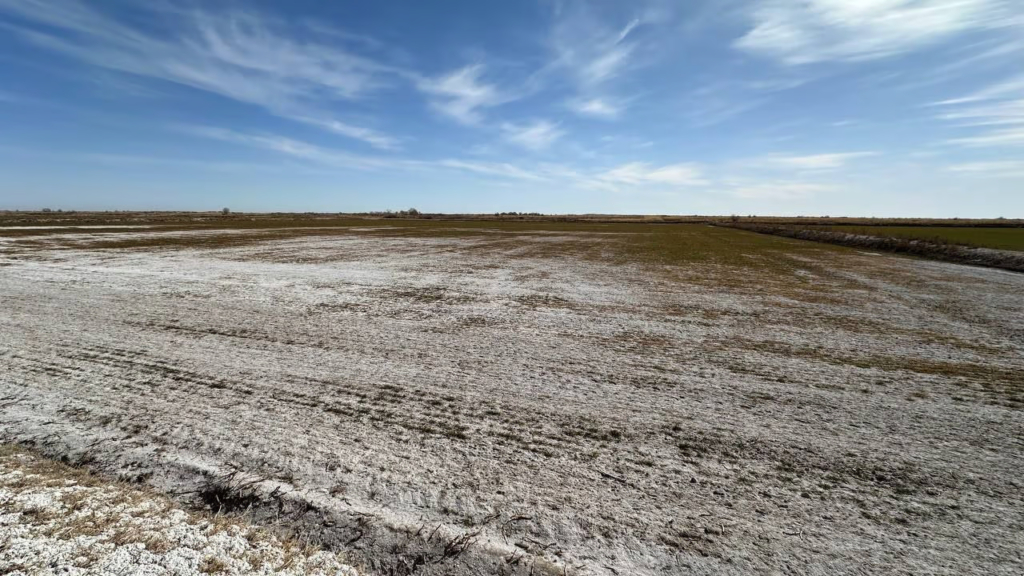
The salt crust on the winter wheat field in Karakalpakstan is not snow, but clear evidence of severe soil salinity.
What treatment program was used on the winter wheat
The following treatment program was applied in the field.
1. Pre-sowing seed treatment
Winter wheat variety Alekseich:
This treatment helps protect the seeds from the very beginning and allows the plant to pass through initial stress more gently.
2. October, emergence / beginning of tillering
- SALTY PRO — 2 L/ha
This is an important stage because plants are especially sensitive to salt stress at the beginning of development.
3. March, tillering stage
- SALTY PRO — 2 L/ha
- Karafos — 300 kg
In spring, the goal was to support the crop after winter, stimulate development, and prevent salt stress from finally weakening the plants.
4. April
- Sporagin — 2 L/ha
- Plantastim — 2 L/ha
- Baktomin — 2 L/ha
- SALTY PRO — 2 L/ha
This program was aimed at comprehensive crop support: stress relief, root system support, improvement of overall plant condition, and maintenance of vegetation under difficult background conditions.
Condition of winter wheat in early April after applying the treatment program with SaltiPro, Sporagin, Plantastim, and Baktomin.
[caption id="attachment_1611" align="alignnone" width="758"]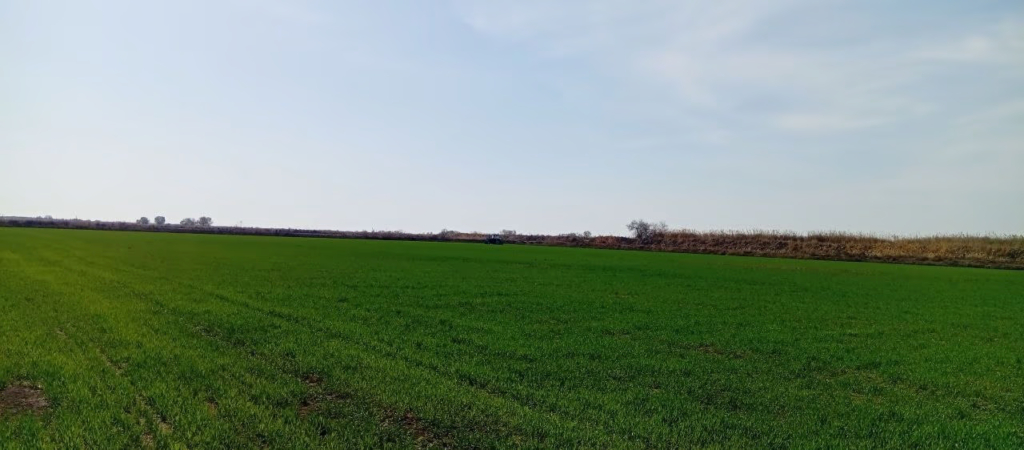 [/caption]
What was the result
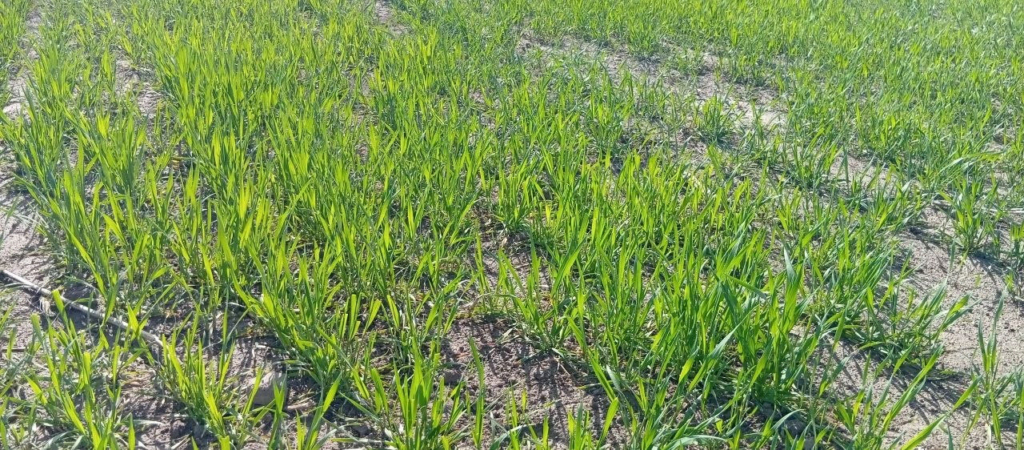
The main result of this case is that even under conditions of severe soil salinity, with a visible salt crust on the field and without leaching, the winter wheat not only survived, but by early April continued normal development.
Based on the visual condition of the crop, it is clear that the plants are alive, green, and continuing to grow. Under such a difficult background, this alone is already evidence that the technology worked not only formally, but under real field conditions.
This case is especially valuable for three reasons:
1. Severe stress background
This was not a field with a slight salinity risk, but an area with clear signs of heavy salt stress.
2. No soil leaching
There were no additional water costs for washing salts out of the soil.
3. Practical field result
This was not a laboratory trial or a greenhouse model, but a working treatment program on a real field in Karakalpakstan.
Condition of winter wheat in early April after applying the treatment program with SaltiPro, Sporagin, Plantastim, and Baktomin.
Why this technology matters for farmers
For farms working on saline lands, solutions are especially valuable when they can be integrated into standard crop production practices without excessive additional costs.
In this case, the program showed that even in a problematic field it is possible to:
- support winter wheat in the early stages of development,
- reduce the consequences of salt stress,
- preserve crop viability and development,
- work without additional field leaching.
This is especially relevant for regions where water is limited.
Case summary
Region: Republic of Karakalpakstan
Crop: Winter wheat
Variety: Alekseich
Problem: Severe soil salinity, salt crust, salt stress
Field feature: Located near a drainage collector
Soil leaching: Not carried out
Pre-sowing treatment: Sporagin 2 L/t + SaltiPro 2 L/t
October: SaltiPro 2 L/ha
March: SaltiPro 2 L/ha + Karafos 300 kg
April: Sporagin 2 L/ha + Plantastim 2 L/ha + Baktomin 2 L/ha + SaltiPro 2 L/ha
Result: Under severe salinity and without field leaching, the winter wheat survived and was developing normally by early April.
Final conclusion
The field experience in Karakalpakstan showed that even under severe soil salinity and pronounced salt stress in winter wheat, it is possible to preserve the crop and support normal plant development if the technology is applied early and systematically.
The use of the treatment program with SALTY PRO, Sporagin, Plantastim, and Baktomin on Alekseich wheat made it possible to carry the crop through a severe stress background without field leaching and without additional water costs for salt washing.
For farms working on saline lands in Karakalpakstan and in other regions with similar conditions, this is a practical example showing that even under difficult conditions it is possible to obtain viable and normally developing crops.
Read also our other wheat-related articles: “Rust on Wheat” and “Fusarium on Winter Wheat”.
