


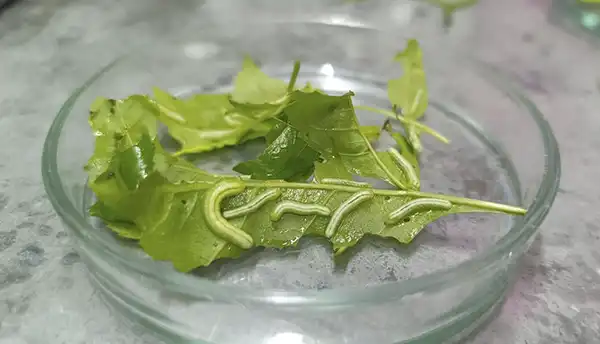
Caterpillars on Plants: Saving the Harvest with Prestij Insecticide
Caterpillars on Plants: Saving the Harvest with Prestij Insecticide
With the onset of warm weather, active caterpillar reproduction is observed on many crops. These pests quickly damage leaves, young shoots, ovaries, buds, and fruits, which can lead to the loss of a significant part of the harvest. What makes them especially dangerous is that when caterpillars develop in large numbers, they can severely weaken plants in a short period of time and reduce their productivity. When infestation is light, losses may be moderate, but when pests multiply massively, the damage increases sharply. In vegetable growing and horticulture, crop losses caused by pests can in some cases reach 46–100% if protection is not provided in time. On certain crops and under severe defoliation, caterpillars can weaken plants very quickly and sharply reduce yields. In addition, weakened plants become more susceptible to various diseases, including viral ones.
Under severe caterpillar infestation, the following can be observed:
- chewed leaves;
- reduced leaf surface area;
- slowed plant growth;
- poorer flowering and fruiting;
- reduced yield quantity and quality;
- weakened plant immunity.
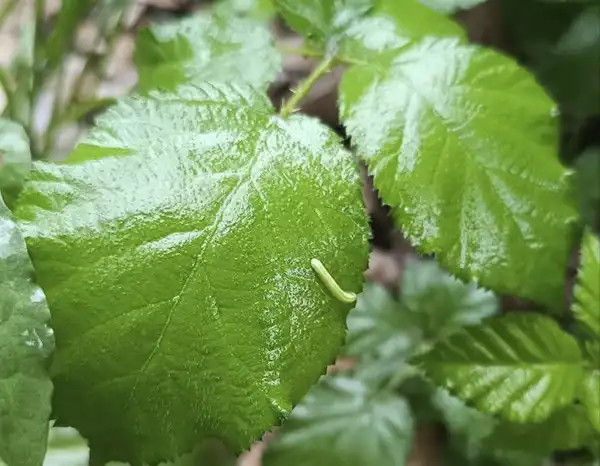
Many farmers face the problem that caterpillars on plants appear suddenly and spread very quickly. If timely measures are not taken, the pest can cause serious damage to fields, greenhouses, orchards, and berry plantations.
Which Crops Are Damaged by Caterpillars
Caterpillars can damage a wide range of crops. They are especially common on:
- vegetable crops (tomatoes, cucumbers, sweet peppers, cabbage, etc.);
- fruit trees (apple, sour cherry, sweet cherry, apricot, vineyards, etc.);
- berry crops (blackberry, strawberry, raspberry, blueberry, etc.);
- melon crops (watermelon, melon);
- ornamental plants;
- field crops (cotton, alfalfa, wheat, maize, rice, etc.).
The pest can damage leaves, buds, young shoots, and ovaries. Therefore, plant protection against caterpillars should be carried out in a timely manner, especially during the period of active pest reproduction.
Prevention Against Severe Infestation
1. Inspect Plants Regularly
The first rule is to check your crops as often as possible. It is especially important to inspect:
- the upper and lower sides of leaves;
- young shoots;
- growth points;
- buds, ovaries, and fruits;
- areas where pests have been seen before.
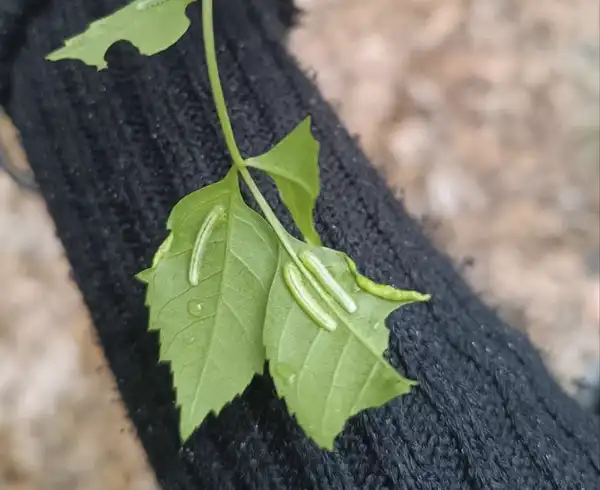
If you notice fresh feeding damage, webbing, caterpillar droppings, or the larvae themselves on the leaves, it means the pest is already active and control measures should not be delayed.
2. Start Control as Early as Possible
Young caterpillars are easier to destroy than large ones. Once the pest has grown, it causes greater damage to the plant and becomes more difficult to control. Therefore, the best strategy is to treat plants at the first signs of caterpillar appearance, not after the leaves have already been severely eaten.
3. Remove Infestation Spots by Hand
If the infestation is still limited, it is useful to remove immediately:
- leaves with egg masses;
- severely damaged plant parts;
- web nests.
4. Prevent Overcrowding of Plantings
Heavily crowded plants are less ventilated and harder to inspect. In such conditions, pests are easier to miss, and treatment is less even.
5. Destroy Weeds and Plant Residues
Many pests first develop on weeds or wild plants and then move to cultivated crops. Therefore, removing weeds around the field and eliminating infected plant residues after the season is an important part of prevention.
6. Repeat Treatment If Necessary
Caterpillars often appear in more than one wave. Therefore, one treatment is sometimes not enough. If larvae continue to emerge or the risk of new infestation remains, repeated treatments according to the recommended schedule are necessary.
When Caterpillar Treatment Should Be Carried Out
The earlier control begins, the higher the protection efficiency. Treatment is recommended at the first signs of pest appearance:
- when young caterpillars are detected;
- when fresh leaf damage appears;
- when the first infestation spots are noticed;
- during the active feeding period of the pest.
If treatment is delayed, the caterpillar population may increase sharply, and the level of plant damage will become much greater.
Laboratory Testing of Prestij
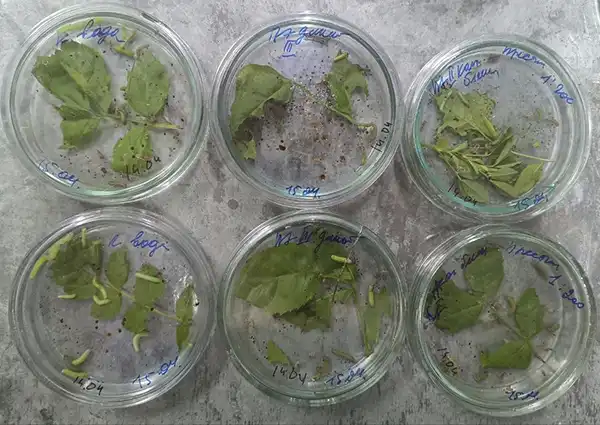
In our laboratory, trials were carried out to evaluate the action of Prestij against caterpillars. During the observations, it was confirmed that the caterpillars died after treatment.
The results once again demonstrated the high effectiveness of the product against leaf-eating pests. The trials confirm that Prestij against caterpillars can be used as a reliable biological solution for plant protection.
How Prestij Works Against Caterpillars
Prestij is a biological insecticide with stomach-contact action. After treatment, when the active components enter the pest’s body, vital biological processes in caterpillars are disrupted, causing them to stop feeding and eventually die.
The advantage of this approach is that the product works specifically against the pest and can be used in biological plant protection systems.
The product contains:
- Bacillus thuringiensis spores;
- protein crystals / endotoxins.
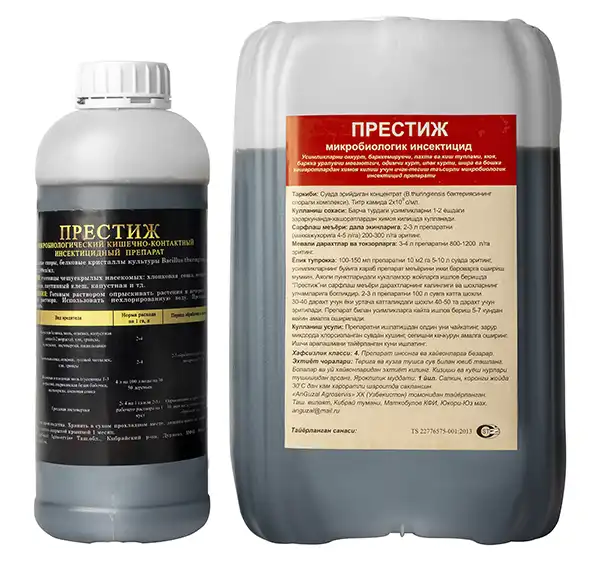
Prestij is used against caterpillars and other harmful insects, including:
- cotton bollworm;
- gypsy moth;
- leafrollers;
- cabbage moth / cabbage cutworm;
- other caterpillars of lepidopteran pests.
According to published studies, the effectiveness of products based on Bacillus thuringiensis can be very high: in laboratory trials, pest mortality often reaches 80–93% or more, and in some experiments the survival rate of caterpillars after treatment dropped to 1–10% at higher working exposure levels.
How to Use Prestij More Effectively
To make the product work better, it is important to apply it not when the leaves are already almost completely eaten, but at the first signs of young caterpillar appearance. This is one of the most important points, because Bacillus thuringiensis-based products work better on early larval stages, while the larvae are still actively feeding.
1. Regularly inspect the plantings
If you see fresh chewing damage, small caterpillars, or the first damaged spots on leaves, it is already time to prepare for treatment.
2. Treat young caterpillars
The younger the larva, the better the result. Large caterpillars are usually harder to control.
3. Ensure good leaf coverage
Since the product works through ingestion of the treated surface and partly by contact, it is important that the working solution thoroughly covers the leaf surface, especially the areas where the pest is feeding.
4. Do not delay repeated treatment if the pest continues to emerge
On different crops, the product is applied 2–3 times during the growing season at intervals of about 5–7 days, and in some cases 5–6 days. This is necessary when caterpillars emerge in waves.
If you need an effective product against caterpillars, a bioinsecticide for plants, a remedy against leaf-eating pests, or a biological product for crop protection, pay attention to Prestij.
For more details, please contact our Telegram channel.
